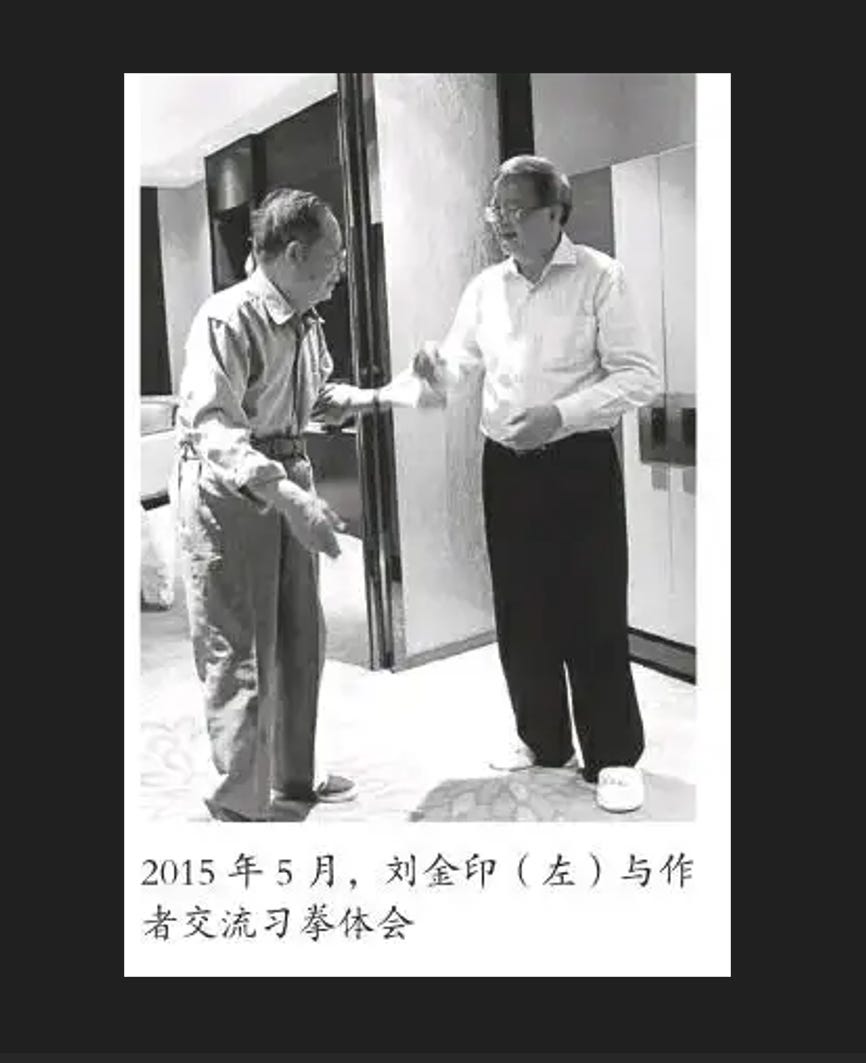
2014 Liu Jinyin Interview
Learning Taiji with Master Wang Yongquan

§ This 2014 interview of Liu Jinyin was published in:
Wenshi Bolan • History & Culture, Issue 7, July 2017
(文史博览·文史2017年7期 刊登)
Summary of the interview:
§ Liu Jinyin characterizes Master Wang Yongquan’s approach to Taijiquan training as firmly rooted in traditional principles, with health cultivation as its primary aim. Master Wang emphasized nourishing internal Qi rather than pursuing overt strength or technical combat skills. For Liu, this orientation distinguishes Master Wang’s transmission from modern, standardized Taijiquan forms that prioritize external shape and uniformity. Master Wang taught that authentic Taijiquan trains both body and mind together, externally refining structure and internally cultivating Qi, so that balance, vitality, and longevity naturally emerge. Skill and function, including martial application, are regarded as secondary and dependent upon this internal foundation.
Central to Wang Yongquan’s teaching, as Liu explains, was the concept of a center (中). Wang taught that maintaining one’s own center means preserving physical alignment, mental calm, and internal equilibrium, while in application one seeks the opponent’s center indirectly, without force. Liu emphasizes that this was not an abstract idea but an extremely concrete training principle: misalignment or tension in any joint disrupts the whole body, while correct central balance allows relaxation, sinking, and uprightness to come into play. Master Wang repeatedly stressed that without genuine relaxation there is no Taijiquan, and that relaxation must be both external (postural) and internal (mental and energetic), with the latter being decisive.
Liu further highlights Master Wang Yongquan’s insistence on naturalness and comfort as the ultimate criteria of correct practice. Wang discouraged forceful striving, tension filled pushing hands competition, and rigid standing post practices, warning that these could damage the body rather than nourish it. Training is to proceed gently, guided by awareness rather than muscular exertion: “use Qi to nourish, use force and you injure.” Liu recalls that Wang taught students to pause, self-check, and ensure each posture felt comfortable and harmonious. Over time, this approach leads toward an increasingly subtle state with less fixation on form or technique and more reliance on intention and ease, where Taijiquan becomes a way of living in accordance with natural balance rather than merely a physical exercise.
Text of the Interview
“Only When Body and Mind Are Relaxed Can One Cultivate Health”
Liu Jinyin:
I liked Taijiquan ever since I was a child and practiced it for several decades. Later, I studied for several years with Mr. Wang Yongquan in his later years. At that time, there were no video or audio recordings. Mr. Wang and I were neighbors. Our homes were only a few minutes’ walk apart, so I often went to his house, where I sought his instruction.
Taijiquan is part of traditional Chinese culture. I mainly practice it for health, and my understanding of Taijiquan itself is rather limited. Because I was relatively familiar with Mr. Wang’s way of speaking, and because I work as an editor with written materials, I organized and compiled his talks so as to facilitate the transmission of Taijiquan. That is all I did. However, the compilation is far from ideal and contains many shortcomings. I would very much like to hear everyone’s opinions.
Ouyang Bin:
I have carefully studied both Mr. Wang Yongquan’s Oral Teachings on Yang-style Taijiquan, with Boxing Photographs, which you compiled, and The True Explanation of Yang-style Taijiquan, compiled by Mr. Wei Shuren and Mr. Qi Yi. I believe that The True Explanation of Yang-style Taijiquan is a standard textbook of Yang-style Taijiquan and an introductory manual.
As for Mr. Wang Yongquan’s Oral Teachings on Yang-style Taijiquan, I agree with the evaluation given by Mr. Wang’s son, who said that it “possesses extremely valuable documentary significance.” The records in your book preserve the material in its original form. I see that you wrote that you began studying Taijiquan with Mr. Wang Yongquan at the Chinese Academy of Social Sciences.
Liu Jinyin:
That was from 1981 to 1987. Mr. Wang taught here for ten years. I missed the first three years and studied for seven years, three times a week, on Saturdays and Sundays, plus an additional weekly visit to his home for individual consultation.
Ouyang Bin:
You’ve said that you studied Yang-style Taijiquan mainly for health. After learning it, what has been your greatest experience in terms of health cultivation?
Liu Jinyin:
The effects on health were very evident. When I was pursuing my doctorate, I had to complete three years’ worth of Soviet coursework in two years, studying more than ten hours a day. My brain became exhausted, and I developed neurasthenia. In addition, after the Cultural Revolution, I developed high blood pressure and had to rely on medication.
After studying with Mr. Wang for just half a year, my hypertension was resolved, and my sleep problems were resolved as well. Why? Because once you relax, the capillaries fully open, blood pressure decreases, and so the blood pressure comes down. Many of us here have lived long lives. Of the more than ten people who practiced together at the time, about half are still alive. Four of them are now over ninety years old. Mr. Wei himself passed away at the age of ninety. So from the perspective of health, the effects are indeed very significant.
Ouyang Bin:
Then what would you say is the optimal effect?
Liu Jinyin:
The optimal effect is cultivating both body and mind and nurturing internal Qi. How does one nurture internal Qi? Mr. Wang believed it was mainly achieved through practicing the form (盘架子), and he did not advocate standing meditation (站桩). Practicing the form means relaxing the entire body and relaxing the mind. Mr. Wang did not advocate chasing “skill” or training to exhaustion. He emphasized complete relaxation of the body.
First and foremost is relaxing the heart-mind and mental awareness, maintaining a pleasant emotional state. This is the regulation of emotions within health cultivation. Western medicine also emphasizes this: inner calm and happiness.
Mr. Wang once said that when he practices, it feels beautiful to himself, and it also looks beautiful to others. His heart feels sweetly content. Some people chase “skill,” glaring with their eyes, pursing their lips, holding their breath, twisting awkwardly, rigidly holding postures, gripping force. Their Qi and blood do not flow freely, this will not do. Practicing Taijiquan is actually self-appreciation and self-entertainment. One should not worry about how others see you.
Some people are very tense, afraid their movements won’t look good. I once wanted to watch Mr. Wang practice in the morning, but he said, “Don’t watch. I don’t look like anything when I practice. There is no form and no appearance; I just move the spirit, intention, and Qi.”
“Nurturing Internal Qi Through the Realm of ‘Nothingness’”
Ouyang Bin:
How should we understand what Mr. Wang meant by “shapeless and formless”?
Liu Jinyin:
At the highest level, Taijiquan has no external form or shape. “No form and no shape” means moving the spirit, intention, and Qi. The most important aspect of Taijiquan for health is nurturing spirit, intention, and Qi. Qi here refers to what Chinese medicine calls internal Qi or original Qi.
Therefore, body and mind must be relaxed. One must not constantly think about how to Peng (“ward off”), how to Lü (“roll back”), or how to strike someone.
Ouyang Bin:
So these concepts should not be in the mind.
Liu Jinyin:
There should be no concept of an opponent. This is extremely important for health. Taijiquan is fundamentally different from Western exercise concepts. Western exercise emphasizes movement, often intense movement to the point of extreme fatigue. For example, in volleyball training, one practices until one can no longer move, until reaching one’s limit, and only then stops. We believe this damages the body and Qi and is not beneficial for long-term development.
Taijiquan emphasizes comfort. I once looked up the difference between “comfortable” (shushi) and “at ease” (shufu). “Comfortable” refers to an external environment that feels pleasant; “at ease” means the entire body feels smooth and unimpeded, with Qi and blood flowing freely. Taijiquan emphasizes emotional state and the joint cultivation of body and mind. This can be integrated into our daily lives, studies, and interactions with others.
Many practitioners’ biggest problem is tension throughout the body, holding themselves rigidly, chasing skill, training bitterly. In reality, one must relax, so much so that even the internal organs are relaxed. Thus, one seeks the realm of “nothingness,” with no concept of an opponent.
Once, while we were studying, a student arrived late. Another student explained to him what the teacher had said that day, this is called listening, this is called seizing, the intention goes from here to there. I listened and felt that it did not match what the teacher had said. I asked the teacher whether learning this way was acceptable. He said it was not. When I practice, he said, there is nothing, I pursue nothing. This is the concept of “nothingness.” But when I need to use it, everything is there: existence is non-existence, and non-existence is existence. When your intention goes there, it already exists; when you truly need to use it, if you are tense, then nothing is there.
Relaxation is very difficult to achieve. Without relaxation, the results are poor. Some people chase “skill,” but skill cannot be chased. This is the difference between health cultivation and self-defense. Health cultivation is about nurturing internal Qi, just as athletes cultivate physical strength and endurance.
“The Value of Practice Lies in the Integration of Inside and Outside”
Ouyang Bin:
From the perspective of health, what instruction from Mr. Wang left the deepest impression on you? For example, the old six routines of Taijiquan, viewed from the health perspective, embody the principle of following nature.
Liu Jinyin:
Let me interject: nature is the central guiding idea. In Yang-style Taijiquan, naturalness and comfort, and ease with dignity, are not parallel concepts, nature is the commander.
Ouyang Bin:
For example, the book mentions practicing eight times a day. My understanding is that one may practice from the first routine through the sixth, or practice only the first or second; one may go from the sixth to the third; or practice only a few movements, whatever feels best. This, to me, is natural. If every session strictly follows a fixed procedure, it becomes forced. Procedures exist, but creativity is also needed. It is like calligraphy: copying model texts is akin to practicing from the first routine to the sixth, but expressive writing does not require rigid adherence to that order. Creativity must not depart from established principles.
Liu Jinyin:
That is “following one’s heart without overstepping the bounds.” Mr. Wang’s routines were very complex, with many transitional movements, far more than the standard 89-posture form. There were well over a hundred movements. For example, “Grasp the Sparrow’s Tail” involved far more than four movements; “Parting the Wild Horse’s Mane,” “Step Forward, Deflect, Parry, and Punch,” and others all included many added transitions.
My point is that how many postures you perform is not important. What matters is not external form but the circulation of internal Qi.
Ouyang Bin:
Learning Taijiquan also requires life experience and understanding.
Liu Jinyin:
Yes, just like writing calligraphy or composing essays, it requires experience. How many routines you practice is not important. What matters is how you practice: cultivating both body and mind, integrating inside and outside, and pursuing the nurturing of internal Qi and the movement of spirit, intention, and Qi.
Thus, understanding the training frame means recognizing that skill emerges from the frame. Some people believe push-hands alone is sufficient; I do not agree. The frame is foundational, just like athletes training strength and endurance. Training spirit, intention, and Qi is fundamentally training Qi.
As for how to train Qi well, Mr. Wang spoke of the “skill of knowing oneself” and the “skill of knowing the other.” Both are Taijiquan skills. This was Mr. Wang’s development of the art and is highly significant.
Many older people practice Taijiquan simply for health, yet today many do not recognize the “skill of knowing oneself” and believe push-hands alone defines Taijiquan. As a result, many older practitioners feel compelled to practice push-hands, which makes relaxation difficult. Once they make contact, it becomes even harder to relax.
Mr. Wang’s emphasis on the “skill of knowing oneself” stresses relaxation. Without relaxation, nothing else can be discussed, neither health nor self-defense. Relaxation is the fundamental skill, yet very few people can truly achieve it today.
“Relaxation, Dispersion, and Free Flow Lead Back to Nature”
Ouyang Bin:
Relaxation depends on letting go. Only by letting go can one relax. How do you understand the concept of “emptiness”?
Liu Jinyin:
Mr. Wang’s understanding of “relaxation” differs from others’. Many people say relaxation means loosening from head to feet. Mr. Wang said this is insufficient. If you only relax downward, everything collapses onto the feet. You must also relax upward, from the soles of the feet, through the ankles, waist, and up to the head.
Ouyang Bin:
So relaxation must go both downward and upward.
Liu Jinyin:
That is still not enough. One must also relax left and right, and outward in all directions. Relaxing outward in all directions is called “dispersion” (散). This concept rarely appears in general Taijiquan texts. “Dispersion” is a defining characteristic of Wang-transmitted Taijiquan. It is a further stage of relaxation—relaxation in all directions.
Ouyang Bin:
Only when one relaxes and disperses can there be free flow; only when there is free flow can there be emptiness.
Liu Jinyin:
Free flow first reaches the hands and feet, but not only those, it extends outward in all directions. However, there is a limit; unlimited expansion exhausts the spirit. One should flow only until it feels comfortable. Free flow means Qi and blood circulate smoothly. At first, one feels numbness, swelling, and warmth. This is the initial stage. Later, the numbness and swelling disappear, leaving only warmth.
Relaxation, dispersion, create flow that forms a sphere. Taijiquan often uses the concept of the sphere. Some imagine holding a barrel, some a ball. Mr. Wang’s concept of the sphere is different: it is not about holding a ball, but about becoming a ball oneself. The entire body is a sphere. Opening and closing are the sphere expanding and contracting; movement assists the opening and closing of intention and Qi.
Mr. Wang had a famous saying: internal Qi drives external form; external form must not drag internal Qi. When external form drags internal Qi, it is no longer natural.
In self-defense, the requirement for flow is much higher. The greatest difference between self-defense and health cultivation lies in flow. In self-defense, spirit, intention, and Qi must flow outward, one to three feet, to penetrate the opponent. This sounds mysterious and is debated today: some say it is material, others say it is mental. Traditionally, it refers to penetration, though contact is still required. To strike someone without contact is something our teacher said he could not do.
You mentioned “emptiness.” The human body contains internal organs and cannot be physically empty. So what is “emptiness”? Emptiness means there is no sensation, no effort anywhere. One feels as if one does not exist; everything feels comfortable. That is emptiness.
Ouyang Bin:
As Venerable Master Hsing Yun said, emptiness is precisely that which contains everything.
Liu Jinyin:
Emptiness is very difficult to achieve, especially for those who chase skill. Whether or not one outputs Qi, and to what degree, marks the dividing line between health cultivation and self-defense. Those of us pursuing health do not output external Qi.
When Mr. Wang first met me, he asked, “What is your purpose in practicing Taijiquan?” I said, “I am already in my fifties; I practice Taijiquan for health and to treat illness.” He said, “If you practice for health, do not practice push-hands with others who are unskilled. Push-hands can damage internal Qi, especially with those who lack skill. Locking horns and competing easily damages internal Qi. With skilled practitioners, push-hands does not harm internal Qi and can even feel very comfortable afterward, with smooth Qi and blood flow.”
Therefore, for health cultivation, relaxation, sinking, vertical alignment, central balance, and ease are most important. One must adjust posture and emotional state. When I practice in summer, my skin relaxes, and I feel as if a breeze passes over the hairs of my entire body.
As I said earlier, nature is the guiding principle. Nature means no external force imposed, no artificial interference. Dialectics speaks of the unity of opposites and transformation under certain conditions. All of this exists within Taijiquan, yin and yang, emptiness and fullness, advance and retreat, the Eight Trigrams. If one feels comfortable after practicing Taijiquan, the goal has been achieved. If one is panting and exhausted, that is unnatural.
“Recording Truthfully, Without Holding Anything Back”
Ouyang Bin:
Teacher Liu (referring to Liu Yingwen), do you have any questions?
Liu Yingwen:
When I first studied with Teacher Wei, I tested skills with him once. My feeling was that he used nothing, yet the elder clearly had substance. Gradually, I learned some things from him and later realized that these were training methods not transmitted publicly by the Yang family.
After Teacher Wei passed away, we saw your book, and I felt that many confusions from my earlier training were clarified. It’s not that things couldn’t be explained, but after your book was published, many issues became very clear.
Liu Jinyin:
They are still not fully clear. Written language can hardly capture spoken instruction.
Ouyang Bin:
Your records are already extremely valuable. Mr. Wang Zhongming spoke very highly of this book. I believe that revising Mr. Wang Yongquan’s Oral Teachings on Yang-style Taijiquan again would be meaningful both for others and for yourself. For others, it allows valuable material to be shared, enabling the influence of the old Yang-style six routines to spread outward in waves. For yourself, you are now eighty-four; through continued exchange and practice, you may gain new insights, leading to new understanding of your earlier notes. You might consider revising it again around age ninety.
Liu Jinyin:
An editor once suggested that I write another book on Taijiquan, but I believe revising the original is better. My purpose in writing was to pass on Mr. Wang Yongquan’s teachings and let more people know them. I spent over a year reviewing my original four notebooks, making more than two thousand annotation cards, classifying, comparing, and selecting materials. The book is primarily documentary in nature.
Yang Luchan (1799–1872), the founder and grandmaster of Yang-style Taijiquan from Yongnian County, Hebei, was invited by the Qing government to train the Eight Banner troops. He had three sons. He brought his second son, Yang Banhou (1837–1892), and his third son, Yang Jianhou (1839–1917); the other son stayed home to farm.
Yang Banhou trained soldiers in self-defense, while Yang Jianhou taught princes and nobles in the royal households. Wang Yongquan’s father was the chief steward of Prince Pulun’s residence and often supervised or substituted in teaching the prince. Wang Yongquan studied there from ages seven to fourteen, laying his foundation. Later, Yang Jianhou said that it was inappropriate in terms of generational hierarchy for both father and son to study with him, so he designated Wang Yongquan to study with Yang Chengfu, Jianhou’s third son.
Wang Yongquan also had a grand-uncle in the art, Yang Shaohou, Jianhou’s eldest son, who was known for striking fiercely. Few dared approach him. Once, he asked Wang Yongquan to test hands. Seeing that Wang could withstand it, he often practiced with him, and Wang thus learned some skills from him. Therefore, Wang Yongquan was a synthesis of three masters. He would sometimes tell us what he learned from Jianhou, from Shaohou, and from Chengfu—explaining their differences and his own developments. For example, the concept of the Qi sphere came from Jianhou; striking with two fingers came from Shaohou; seizing, relaxation, and lightness came from Yang Chengfu.
“Unveiling the Mystery of the Taiji ‘Sphere’”
Ouyang Bin:
Please speak about the characteristics of Wang-transmitted Taijiquan.
Liu Jinyin:
This remains an ongoing topic. Martial arts speak of the unity of internal and external. The external is bodily movement and form; the internal is the circulation of internal Qi, the movement of spirit, intention, and Qi. Internal training is the cultivation of spirit, intention, and Qi. Wang Yongquan elevated this to a very high level.
Under conditions of internal–external integration, practicing the form trains spirit, intention, and Qi; push-hands applies spirit, intention, and Qi to the opponent, controlling and issuing against the opponent’s spirit, intention, and Qi. This is a key point for understanding Wang-transmitted Taijiquan.
In self-defense, Mr. Wang emphasized the sphere, transmitted from Yang Jianhou. The Qi sphere is a defining feature of Wang’s transmission. It is not an ordinary balloon but an infinite, boundless Qi mass. The skills of knowing oneself and knowing the other are the operation of this Qi mass. Ward-off, rollback, advance and retreat are all movements of the Qi sphere. The postures are movements of the Qi sphere, not of hands and feet. In self-defense, the entire body is a Qi sphere; issuing force is the expansion of the Qi sphere.
He summarized this as listening, questioning, seizing, and issuing. Listening is not with the ears but with the hands, like taking a pulse. Upon contact, one knows the opponent’s condition: where they are relaxed or tense, how their force is applied, where it goes.
Using the Qi sphere to sense and operate: when you strike, my Qi sphere expands and deflects you; when it contracts, expands, and rotates, the result changes. Rotation is extremely important, yet often neglected. The transformations of the Taiji sphere and yin–yang are highly effective in self-defense—turning the fish’s head into its tail, passivity into initiative. Expansion, contraction, extension, retraction, and rotation are all crucial.
Mr. Wang’s Qi sphere differs from others’. Conventional self-defense emphasizes receive, neutralize, and issue. He relied on the Qi sphere to draw in and empty out. When your Qi sphere comes, mine neutralizes it, causing you to lose balance; as you recoil, I issue. The hand carrying the Qi sphere represents the whole body’s sphere.
Others neutralize with the waist, but he said the waist is too slow and too far from the contact point. Instead, he neutralized directly with the hand. This he called “moving the center, shifting the essence.” This is his distinctive method, understood by very few and now on the verge of being a lost part of the art.
In self-defense, “center” is critical. Mr. Wang did not advocate striking where the opponent is tense. He emphasized the center, not a geometric center, but the center of spirit, intention, and Qi, the source of issuing force. Striking the center moves the whole body. This is whole-to-whole, not part-to-part.
Before his death, he told me: the most important thing is the “center.” Protect your own center at all costs, and strike the opponent’s center at all costs. The center is not fixed or external—it is internal, the source of power.
Ouyang Bin:
From studying with you this morning, I have two impressions. First, you have very sincerely transmitted a great deal of knowledge, from which we have benefited immensely. Second, I still suggest recording sections of Mr. Liu Jinyin’s oral teachings. These materials would be extremely valuable to future generations. What Mr. Liu has discussed is an extension of Wang-transmitted Yang-style Taijiquan, and preserving it bit by bit would greatly benefit the Taijiquan community.